About
► View the Game Boy’s 20th Anniversary Special! ► View The Original Game Boy CommercialThis Website
This site made its debut in February of 2010. This site was made for owners of Game Boy, to play and rate their favorite games. I hope you enjoy the site. It features more than 500 original Game Boy games. It’s a great place to play when you have forgotten or misplaced your Game Boy.
Nintendo Game Boy
source: wikipedia.org The Game Boy (ゲームボーイ) is an 8-bit handheld video game device developed and manufactured by Nintendo. It was released in Japan on April 21, 1989 (1989-04-21), in North America on July 31, 1989 (1989-07-31), and in Europe on September 28, 1990 (1990-09-28). In Southern Asia, it is known as the “Tata Game Boy” It is the first handheld console in the Game Boy line, and was created by Gunpei Yokoi and Nintendo’s Research and Development the same staff who had designed the Game & Watch series as well as several popular games for the Nintendo Entertainment System.
The Game Boy is Nintendo’s second handheld system following the Game & Watch series introduced in 1980, and it combined features from both the Nintendo Entertainment System and Game & Watch. It was also the first handheld game to use video game cartridges since Milton Bradley Company’s Microvision handheld console. It was originally bundled with the puzzle game Tetris.
Despite many other, technologically superior handheld consoles introduced during its lifetime, the Game Boy was a tremendous success. The Game Boy and Game Boy Color combined have sold 118.69 million units worldwide. Upon its release in the United States, it sold its entire shipment of one million units within weeks.
Features
The Game Boy has four operation buttons labeled “A”, “B”, “SELECT”, and “START”, as well as a directional pad. There is a volume control dial on the right side of the console and a similar knob to adjust the contrast Game Pak slot — Insert the Nintendo GAME BOY Game Pak here. Normally, users leave the cartridge in the system as recommended by Nintendo to prevent dust and dirt from entering the system.
The Game Boy also contains optional input and/or output connectors. On the left side of the system is an external power supply jack that allows users to use an external rechargeable battery pack or AC adapter (sold separately) instead of four AA batteries. The Game Boy requires 6V DC of at least 250mA.
A 3.5mm stereo headphone jack is located on the bottom side of the console which allows users to listen to the audio with headphones or speakers.
On the right side is a port that allows a user to connect to another Game Boy system via a link cable, provided both users are playing the same game. The port can also be used to connect a Game Boy Printer. The link cable was originally designed for players to play head-to-head two-player games such as in Tetris. However, game developer Satoshi Tajiri would later use the link cable technology as a method of communication and networking in the popular Pokémon video game series.
Reception
The Game Boy and Game Boy Color combined have sold 118.69 million units worldwide, with 32.47 million units in Japan, 44.06 million in the Americas, and 42.16 million in other regions.
At the time of its release in 1989, the Atari Lynx was also just being introduced to the market. This system featured color graphics, a back lit screen, and networking capabilities. However, its release price of $189.95 and substantial requirement of 6 AA batteries that would provide roughly only four or five hours of game play (compared to 10–12 hours on 4 AA batteries and a release price of $89.99 for the Game Boy) doomed it to a second-rate status. Nintendo also experienced heavy competition from Sega’s Game Gear. To promote its new color console, Sega aired a number of negative but unsuccessful ad campaigns in the United States that criticized the Game Boy’s monochrome color palette. Like the Lynx, it too required six AA batteries that only lasted about 4–6 hours and was much more expensive than the Game Boy. The Game Gear had the advantage of being fully compatible (with an adapter) with all Sega Master System games and, while not as successful as the Game Boy, it sold from 1991 until early 1997.
Official Nintendo Magazine has praised the Game Boy and its models that follow it as it “got people who enjoyed gaming while sprawled on the couch in their undies to game wherever they liked.”
In 2009, the Game Boy was inducted into the National Toy Hall of Fame, 20 years after its introduction.
Technical specifications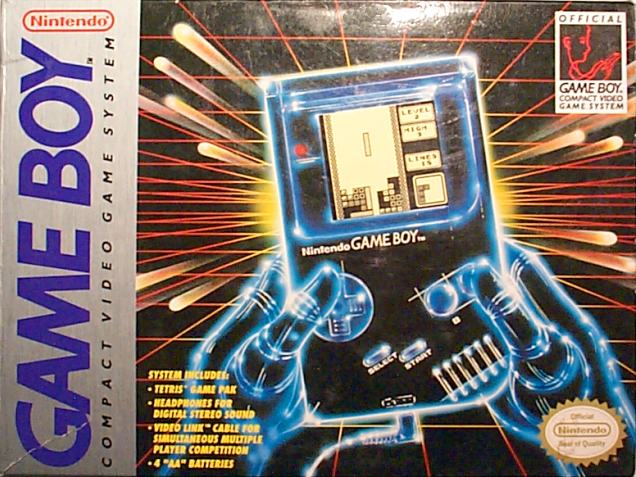
* CPU: Custom 8-bit Sharp LR35902 core at 4.19 MHz which is similar to an Intel 8080 in that all of the registers introduced in the Z80 are not present. However, some of the Z80’s instruction set enhancements over the stock 8080, particularly bit manipulation, are present. Still other instructions are unique to this particular flavor of Z80 CPU. The core also contains integrated sound generation
* RAM: 8 kB internal S-RAM
* Video RAM: 8 kB internal
* ROM: On-CPU-Die 256-byte bootstrap; 256 kb, 512 kb, 1 Mb, 2 Mb, 4 Mb and 8 Mb cartridges
* Sound: 2 square waves, 1 programmable 32-sample 4-bit PCM wave, 1 white noise, and one audio input from the cartridge. The unit only has one speaker, but headphones provide stereo sound
* Display: Reflective LCD 160 × 144 pixels
* Screen size: 66 mm (2.6 in) diagonal
* Color Palette: 2-bit (4 shades of “grey” (green to (very) dark green))
* Communication: Up to 2 Game Boys can be linked together via built-in serial ports, up to 4 with a DMG-07 4-player adapter. More than 4 players is possible by chaining adapters.
* Power: 6 V, 0.7 W (4 AA batteries provide ~14-35 hours)
* Dimensions: 90 mm (W) x 148 mm (H) x 32 mm (D) / 3.5″ x 5.8″ 1.3″ (in)